

New report highlights how office users can take action against climate change
New report highlights how office users can take action against climate change
Office users around the world must take drastic action if the buildings and construction sector is to reduce its carbon footprint in keeping with international agreements. It is high time to help office occupiers towards flexible ways of working and towards an efficient zero-space-waste, zero-emission target. A new global workplace study of some 1800 workplaces finds that offices are half-empty even during the busiest work hours, creating a wasteful supply chain with gigantic negative implications.
Optimaze Workplace Review 2019 - Rapal Oy’s annual space utilization benchmark report - has been published. The report is based on nearly 1,800 observational space utilization studies conducted between 2014 and 2018 and offers insights into how tenants use workplaces around the world.
In sum, there is great inefficiency in space use, which impacts business, employee experience, and the climate.
Commercial Real Estate has a substantial carbon footprint
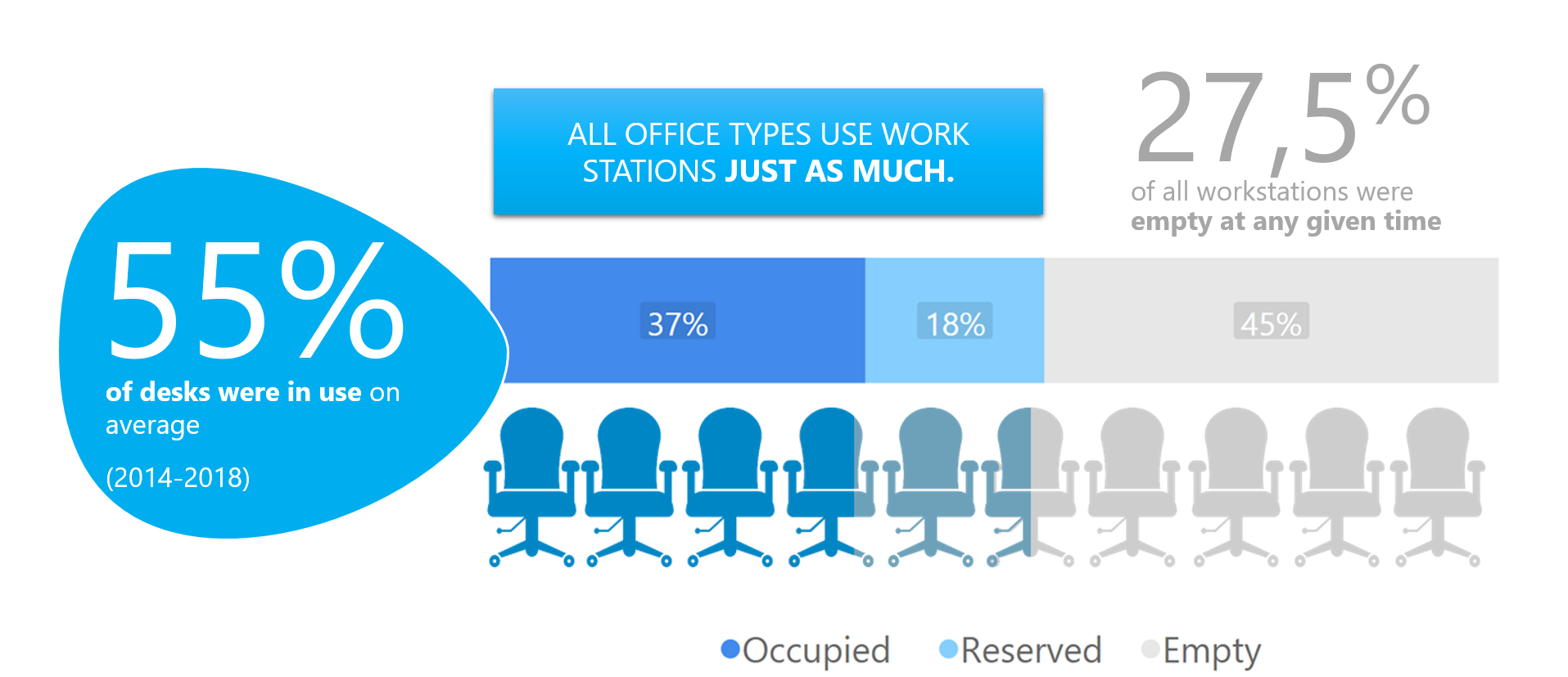
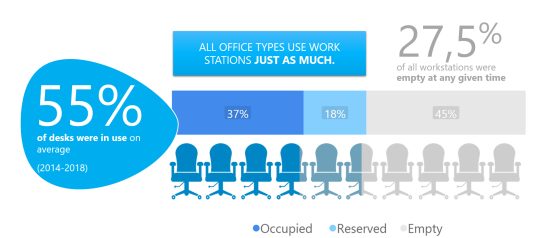
The report finds that on average only 55 percent of all workstations and 42 percent of meeting spaces are used during an average workday during peak hours. And not only that, about 80 percent of all meetings are attended by four people or less, leaving over-sized meeting rooms filled up to only 19 percent of their maximum capacity.
Energy efficiency gains in real estate are slowly shifting towards cleaner energy and energy saving technologies. But a lot remains to be done. We need to start recognizing just how much space we are heating, cooling, lighting and cleaning in the first place. By embracing the sharing and circular economy, we can make better use of the spaces we already have, according to a new report recently released by Rapal Oy.
When it comes to material efficiency, half of the world’s raw materials (that in themselves create greenhouse gases during manufacturing and transportation) are used in construction. Much of it is wasted even in use of the final product, such as commercial real estate. The buildings sector accounts for a significant 39 percent of total energy-related CO2 emissions and 36 percent of final energy use, according to the World Green Building Council. Therefore, we need to change the way we plan, build, and especially use our buildings also as tenants.
The time for action is now and positive results can be achieved quickly
It is high time for workplace professionals and industry leaders to help steer and nudge office occupiers towards the greater use of circular practices and towards an efficient zero-space-waste, zero-emission target.
The impacts of low space utilization in the offices sector don’t stop there. There are great economic implications as well. Companies around the world waste potentially billions of dollars on under-utilized office spaces that in many ways appear to be unfit for their purpose, to support and boost productive work. There is good news: there is a lot of potential to be leaner and smarter.
“We are especially interested in how technology enabled flex work is on the rise, and how this changes our patterns of work, our space needs, and the use of office space and other locations outside the main office,” says Maija Patjas, Director of Rapal's Workplace Solutions.
She goes on to explain: “The working theory is that this newly found increased mobility is good for employees as well as cost savings in real estate.”
“Our mission is to help companies along on their lean quest for zero waste in their operations, money, material use and emissions. We hope the report encourages discussion about developing more future-proof and sustainable workplace strategies that efficiently boost and support well-being and productive work,” Patjas adds.
Finally, it is not only new technologies that can save us, but a dramatic cultural change in the workplace towards flexible work and a sharing economy in space use and leasing.
The 2019 report highlighted the following themes
Companies continue to allocate about one work space per person regardless of the actual utilization rate. On average only 55% of all workstations are used during an average workday. The studies provide strong evidence that there is an opportunity to consolidate space far more efficiently.
- Nearly two-thirds (65%) of all knowledge workers surveyed were working solo, doing heads down work. Only 28% of the average worker’s time was spent collaborating with others.
- The study found meeting rooms were occupied by a single person 25% of the time. In particular, 9% of activities taking place in open plan office meeting rooms were people making phone calls. Noisy open spaces drive people to seek out quiet, private places to work, such as meeting spaces (for lack of better space) where they conducted phone calls, engaged in distance meetings, and worked on solo tasks.
- Technology and agile working drives meetings to be increasingly smaller. Four out of five meetings took place with groups of four people or less. The survey showed that 29% of all meeting rooms were occupied by only one person. Two-to-four person meetings constituted 51%.
- The more walls and partitions an office had, the larger the meeting sizes tended to be. This is due to less frequent spontaneous interaction and serendipitous collisions and ad hoc meetings, which drives organizations to book costly formal meetings that include more people. This in turn creates less agility and requires more coordination, increased formality in meeting procedures and a decrease in productivity from too many people attending just in case.
- Activity-based offices, which provide great flexibility and a choice-based working environment with an accompanying flexible work culture and cognitive support for various modes of work, comes out on top on all metrics.
More about the Optimaze Workplace Review
Workplace professionals worldwide use our Optimaze Measure and Optimaze Worksense software to perform hundreds of space utilization measurements each year. The valuable data, including how workstations, meeting rooms and other spaces are used, gleaned from these studies, adds to a large database and increases understanding of space utilization in a large variety of organizations. Workplace experts summarize this information annually and, with customers’ consent, share what has been learned in the workplace benchmark report.
The report aims to provide comparative data that can help organizations
- assess the efficiency of their own space use in comparison to others
- understand connections between space and behavior
- set targets for developing existing or defining new office space requirements
The data gathered for this 2019 report summarizes observational workplace study results from 2014 to 2018 from 17 countries. All in all, we have analyzed 1,792 observational space utilization studies, which included:
- 460 buildings
- 136,000 workstations
- 12,600 meeting spaces
- 88,200 meeting seats
- 54,600 other seat types
- over 7.5 million observations of seat use in the past five years.
For more information, please contact:
- Leslie Petersen, Marketing expert, Rapal Oy, leslie.petersen@rapal.com, +358 50 385 2031
- Pontus Kihlman, Executive Consultant, Workplace Solutions, pontus.kihlman@rapal.com,
by telephone +358 40 571 5356 during 15-28 July, 2019
Mer om utgivaren
Rapal in short
Rapal Oy is a member of the Green Building Council Finland (FIGBC), and specializes in management and development of the built environment towards a “zero waste, zero emission” -vision by providing software services. Rapal’s Optimaze software and services assist in management and decision-making towards effective workplaces and real estate that are sustainable from the viewpoints of economy, environment and workplace well-being. The company was established in 1991 and is owned by its personnel. Rapal is headquartered in Finland and has a US-based subsidiary Optimaze, Inc. www.rapal.com